
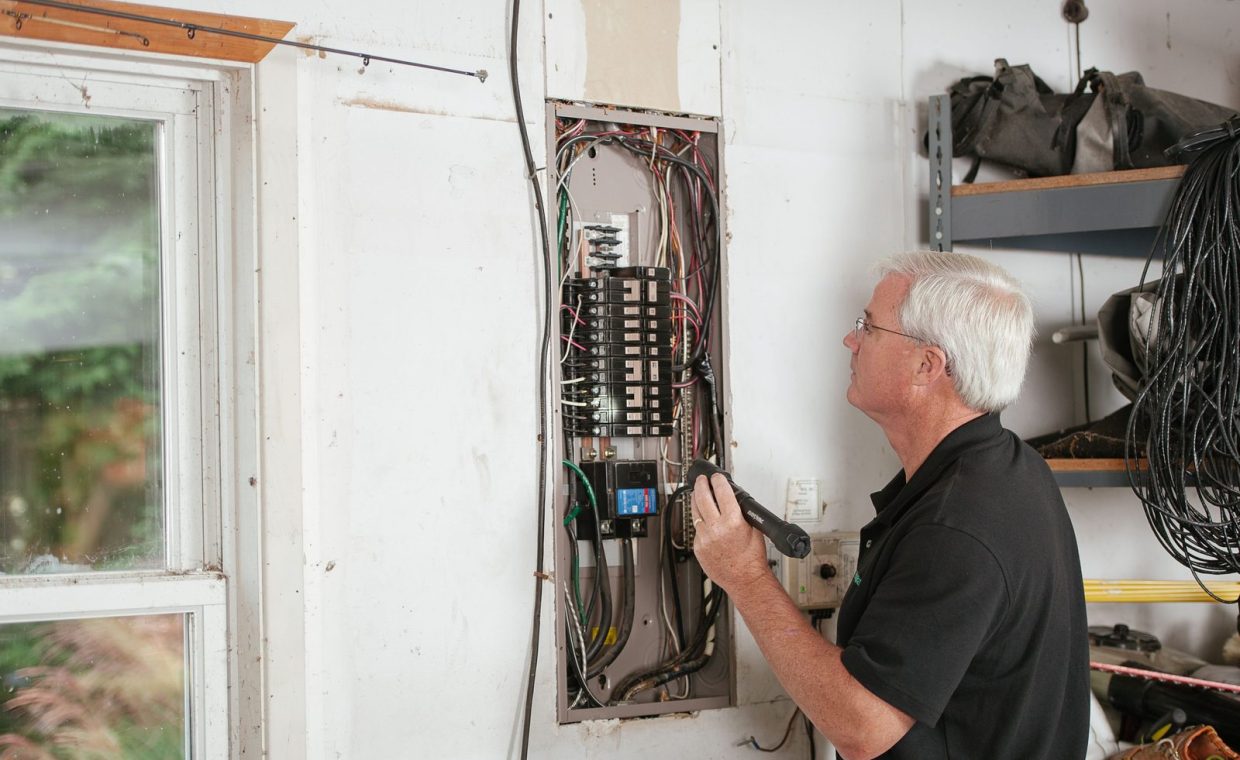
A homeowner called me out to a 1962 ranch last spring because the lights in her living room would dim every time the refrigerator kicked on. She thought it was a bad bulb. When I pulled the cover off her panel, I found a 60-amp fuse box with cloth-wrapped wiring and a junction that had been quietly cooking itself brown for years. That is the thing about old electrical systems. They rarely fail with a bang. They give you small, polite warnings first.
I have been wiring houses for the better part of two decades, and I can tell you most of the dangerous stuff lives behind the walls and inside that gray box in your basement, the part you never look at. So let me walk you through the signs I actually look for on a service call, what they mean, and what the repair tends to run.
None of these numbers are quotes. Electrical pricing swings hard by region, by how buried your panel is, and by what the inspector wants. Treat them as ballpark figures to help you budget, not a bill.
1. Your Panel Still Uses Fuses (or Reads 60 Amps)
If you unscrew a glass fuse when a circuit blows, your home is running on technology that predates the moon landing. A 60-amp service was plenty for a 1950s house with a few lamps and a radio. It is not plenty for a modern kitchen, central air, and a car charger in the garage.
Most homes today want a 200-amp service. Upgrading from 60 or 100 amps usually runs roughly $2,500 to $4,500 installed. That breaks down to maybe $1,200 to $2,000 in labor, $600 to $1,200 for the panel and breakers, and $150 to $500 in permits and the utility coordination fee.
The price climbs fast if the utility has to upsize the line from the pole, or if your meter base and mast need replacing too. I have seen those full jobs touch $6,000 in older neighborhoods.
2. Breakers That Trip for No Obvious Reason
A breaker doing its job once in a while is fine. That is what it is for. But a circuit that trips every time you run the microwave and the toaster together is telling you the circuit is overloaded, or something in it is failing.
Sometimes the fix is cheap. Adding a dedicated 20-amp circuit for a kitchen or a bathroom runs roughly $250 to $700 depending on how far the run is and how easy the wall access is. Finished basements and plaster walls push that higher because of the fishing and patching.
Never solve a tripping breaker by swapping in a bigger one. I see this all the time. A 15-amp breaker on 14-gauge wire exists to protect that wire. Put a 20-amp breaker on it and you have removed the safety net, not the problem.
3. Warm Outlets, Buzzing, or a Faint Burning Smell
This one moves to the top of my list every time. An outlet or switch plate that feels warm to the touch means there is resistance where there should not be, usually a loose connection arcing behind the wall. That arc is how electrical fires start.
If you smell something like hot plastic or fish near an outlet, kill that circuit at the panel and call an electrician the same day. I am not being dramatic. Replacing a burned outlet and its connections is a $150 to $350 repair. Replacing a house after a wall fire is a different conversation entirely.
While we are on the subject of things that quietly cause expensive damage, the same logic applies to slow leaks behind walls. I have seen homeowners spend on water damage repair for problems that started as a tiny drip nobody could see, same as a loose wire nobody could hear.
4. Two-Prong Outlets and No Ground
If your outlets only have two slots and no rounded ground hole, your wiring almost certainly has no ground path. That means surge protectors do not actually protect anything, and a fault in an appliance has nowhere safe to go except through you.
You have two routes here. Rewiring the circuit with proper grounded cable is the right answer but the pricey one, often $1,000 to $2,500 per area depending on access. The code-compliant budget option is installing GFCI protection, which runs roughly $20 to $60 per outlet in parts plus labor, and gives you shock protection even without a ground.
When grounding gets expensive
Knob-and-tube and early cloth wiring cannot simply be grounded. There is no ground conductor in there to connect to. On those homes, the honest path is a rewire, and that is where costs jump into the five-figure range for a whole house.
5. Flickering or Dimming Lights
Back to my ranch homeowner. Lights that dim when a big appliance starts usually point to an undersized service or a loose neutral connection, sometimes at the panel and sometimes out at the meter or the utility's own equipment.
A loose neutral is genuinely dangerous because it can let voltage swing high enough to fry electronics throughout the house. Diagnosing and tightening connections is often a $150 to $400 service call. If the neutral is failing at the panel's main lugs, you are usually looking at a panel replacement.
One flickering light on one switch is probably a bad bulb or fixture. Whole rooms dimming together, or lights across the house pulsing, is a system-level problem. The pattern tells you which.
6. A Panel Brand With a Bad Reputation
Some panels installed from the 1950s through the 1980s have known failure histories where breakers do not trip under fault conditions the way they should. Federal Pacific Stab-Lok and certain Zinsco panels are the two names that make every electrician wince. If you have one, insurers sometimes will not even write a policy until it is gone.
Replacing one of these panels, keeping the same 100 or 200-amp service, generally runs roughly $1,500 to $3,000. It is one of the better safety dollars you can spend in an older home, because the box itself is the problem, not your wiring.
7. Not Enough Outlets, So Extension Cords Live Everywhere
Walk into an older bedroom and count the outlets. Often there is one, maybe two. So people run power strips and extension cords as permanent wiring, which they were never designed to be. That daisy-chained tangle behind the entertainment center is a real fire risk.
Adding outlets to an existing circuit is one of the more affordable upgrades, roughly $150 to $300 per outlet on accessible walls. The cost is almost entirely labor and wall patching, so doing several in one visit lowers your per-outlet price.
If you are already planning bigger mechanical work, it is smart to bundle. Crews are sometimes in your walls anyway during a whole-house repipe, and that open-wall moment is the cheapest time you will ever get to run new electrical too.
8. You're Adding Major Loads the System Was Never Sized For
Maybe you want a heat pump, an EV charger, a hot tub, or a finished basement with its own kitchenette. Older panels often have no spare breaker slots and no headroom on the service for any of it.
A Level 2 EV charger circuit alone runs roughly $500 to $1,500 installed if you have capacity, far more if the panel is full and needs upgrading first. This is also where electrical and comfort upgrades overlap. Moving to an efficient heat pump is one of the better ways to lower your HVAC bills, but it needs a panel with room to breathe.
Have an electrician run a load calculation first. I have watched homeowners buy a $1,200 charger only to learn their panel needs a $3,500 upgrade before it can be plugged in. Knowing the full number up front saves a lot of grief.
What a Full Upgrade Actually Costs
To put the pieces together, here is how the common jobs tend to stack up in today's market.
- Panel swap, same amperage: roughly $1,500 to $3,000
- Service upgrade to 200 amps: roughly $2,500 to $4,500, more with mast and utility work
- Adding a dedicated circuit: roughly $250 to $700
- Whole-house rewire (knob-and-tube era): roughly $8,000 to $20,000 depending on size and access
Permits and inspection are not optional on this kind of work, and I would be suspicious of anyone who offers to skip them. A pulled permit is what gets your job inspected by someone other than the person who profited from it.
How do I know if I have knob-and-tube or cloth wiring?
Look in the attic or basement for individual wires running through porcelain knobs and tubes, or fabric-sheathed cable instead of modern plastic. If you see either, have an electrician assess it. It is not automatically dangerous, but it is old and worth evaluating.
Can I do any of this work myself to save money?
Swapping a single outlet or switch is within reach for a careful homeowner. Anything involving the panel, the service, or new circuits should go to a licensed electrician and through a permit. The labor savings are not worth a fire or a failed home sale later.
Will upgrading my panel lower my insurance cost?
It can, especially if you are replacing a fuse box or a panel brand with a known failure history. Some insurers charge more, or decline coverage entirely, on those systems. Ask your agent before and after the work, since the difference can offset part of the upgrade.
If two or three of these signs sound like your house, you are not in a crisis, but you are on the clock. Old electrical systems do not get better with time, and the small warnings are the cheap part. Get a licensed electrician to pop the cover, run a load calculation, and give you a real number. Knowing where you stand beats finding out the hard way.