
A homeowner called me last spring because her downstairs toilet was gurgling every time the washing machine drained. Classic sign. By the time we got a camera down the line, we found a cracked clay pipe about 18 feet out, roots pushing through the joint like fingers through wet paper.
She was bracing for a $20,000 nightmare. Her actual bill came in around $4,200 because we could dig one pit and fix the bad section. That gap, between the fear and the reality, is why I wanted to lay this out plainly.
Sewer work scares people because it hides underground and the numbers swing wild. One yard the fix is $600. Next door it is $18,000. Let me walk you through what actually drives the price so you can budget like someone who knows the trade.
The Short Answer on Sewer Line Repair Cost
Most sewer repairs land somewhere between $1,500 and $6,000. A small spot repair on an accessible line can run $600 to $2,500. A full replacement of a long run under a driveway or mature landscaping can climb past $20,000.
The pipe itself is cheap. What you pay for is access, depth, and cleanup. Digging is the expensive part, and every foot of concrete, every tree root, every permit adds to the tab.
Budget roughly $50 to $250 per linear foot for trenching methods, and $80 to $300 per foot for trenchless. The wide spread comes down to depth and what sits on top of the pipe.
What You Pay by Type of Job
Not every sewer problem needs the same solution. A single cracked section is a different animal than a collapsed line running the length of your front yard. Here is how the common jobs shake out in 2026 pricing.
| Repair Type | Typical Cost Range | When You Need It |
|---|---|---|
| Cabling / snaking a clog | $150 - $500 | Roots or grease blocking flow, pipe still sound |
| Hydro jetting | $400 - $900 | Heavy buildup, recurring backups |
| Spot repair (one section) | $600 - $2,500 | Single crack or break, rest of line is fine |
| Pipe lining (trenchless) | $4,000 - $12,000 | Old pipe, minor cracks, want to avoid digging |
| Pipe bursting (trenchless) | $6,000 - $18,000 | Collapsed or badly deteriorated full run |
| Full dig and replace | $8,000 - $25,000+ | Collapse under concrete, deep line, or code upgrade |
A camera inspection to find the problem usually runs $250 to $650 on its own. Some companies credit that toward the repair if you hire them. Ask before they drop the camera in.
Trenchless vs Traditional Digging
This is the question I get most. Trenchless sounds magic because nobody wants their lawn torn open. It is a real option, but it is not always cheaper and it does not fit every situation.
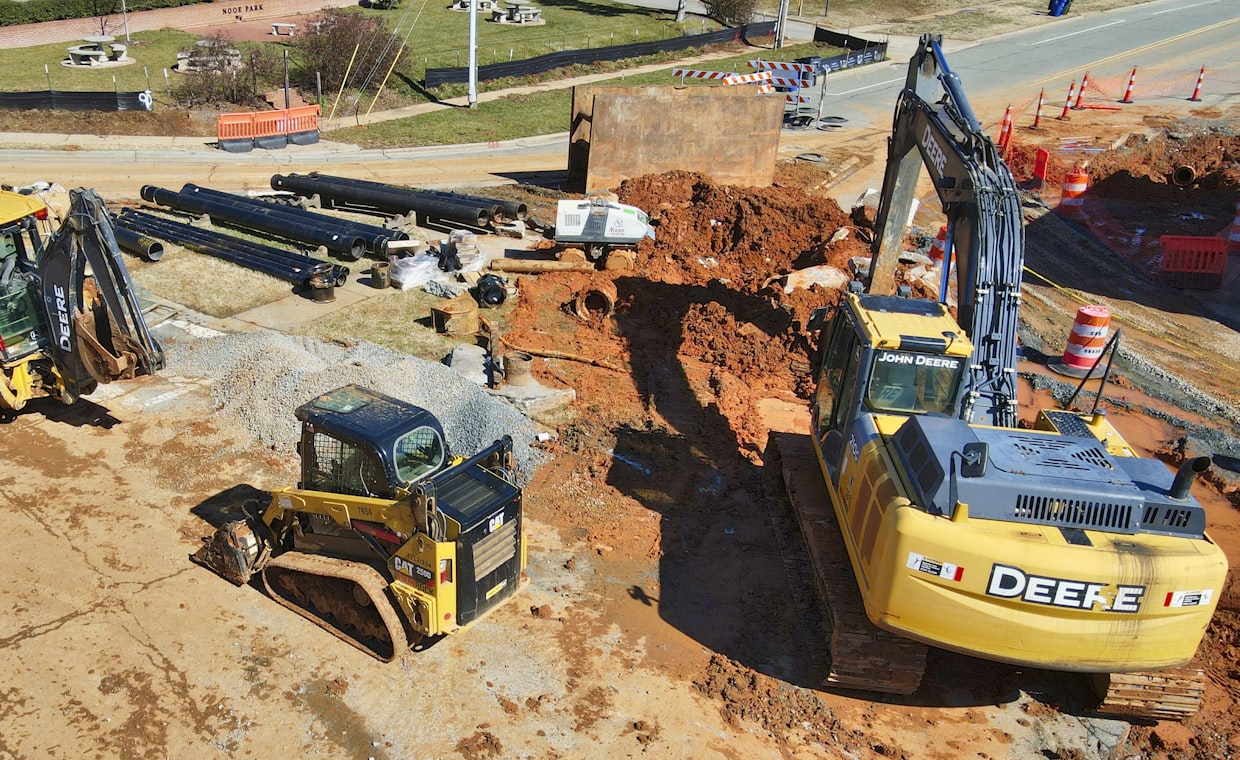
Traditional excavation means digging a trench along the whole line, swapping the pipe, and backfilling. It is disruptive but it works on any pipe in any condition, and the per-foot labor is often lower.
Trenchless (lining or bursting) uses one or two access pits instead of a full trench. You save your driveway and your landscaping, which matters when a stamped concrete patio costs more to replace than the pipe did.
One honest catch: trenchless needs the existing pipe to be intact enough to work with. If your clay line is crushed flat in three spots, the crew shows up, tries, and ends up digging anyway. Now you paid mobilization for both. Get a camera confirmation first.
The Surprise Line Items That Wreck a Budget
The repair quote is rarely the final number. I have watched a $5,000 job turn into $11,000 because of stuff nobody mentioned upfront. These are the ones that get people.
Depth. A line 3 feet down is easy. A line 9 feet down needs shoring, a bigger machine, and sometimes a second day. Depth is the single biggest price multiplier.
Concrete and hardscape. Cutting and repouring a driveway, sidewalk, or garage slab adds $1,500 to $6,000. City sidewalks sometimes need their own permit and inspection.
Permits and inspections. Sewer work almost always needs a permit, $150 to $600 depending on your city. Skipping it bites you at resale.
Where the damage stops. If a broken line let water sit under the slab or seep toward the house, you can be looking at water damage repair cost on top of the pipe work, and in bad cases even foundation repair cost if the soil washed out under a footing.
Who Pays: You, the City, or Insurance
Most homeowners do not realize the sewer line from the house to the city main is usually their responsibility, not the utility's. The dividing line is often the property line or the curb, but it varies by municipality.
Call your city before you pay a dime. Sometimes the break is on their side of the connection, and that changes everything about who writes the check.
Homeowners insurance is a mixed bag. A sudden collapse might be covered. Slow root intrusion and normal wear almost never is. A separate service line endorsement, often $30 to $80 a year, covers the pipe on your property and is worth asking about.
- Confirm whether the break is on your side or the city's side of the connection.
- Ask if your insurance has (or can add) a service line endorsement.
- Get the camera footage. If they cannot show you the damage, do not sign.
- Ask for the quote to spell out concrete restoration and permits separately.
How to Keep the Bill Down
Get two or three quotes, and make sure they are quoting the same scope. One guy pricing a spot repair against another pricing a full replacement is not a comparison, it is a trap.
If your line is old clay or Orangeburg (that tar-paper pipe from the 1950s and 60s), plan ahead instead of waiting for a 2 a.m. backup. Emergency work always costs more, and a rushed homeowner overpays. A little foresight is the cheapest tool you own, which is the whole idea behind learning to prevent expensive repairs before they turn urgent.
Simple habits help too. Keep roots trimmed near the line, do not flush wipes even the "flushable" kind, and jet the line every few years if you have known root pressure. A $500 maintenance jet beats a $12,000 replacement.
How do I know if I need a spot repair or a full replacement?
A camera inspection is the only honest way to tell. If the footage shows one clean break with sound pipe on both sides, a spot repair fits. Multiple breaks, sagging (called bellies), or widespread root intrusion usually points to lining or full replacement.
Is trenchless sewer repair always more expensive?
Not always. Trenchless costs more per foot for the pipe work, but it can come out cheaper overall when you factor in not tearing up and repouring a driveway, patio, or mature landscaping. On an open, shallow yard, traditional digging is often the better deal.
Will homeowners insurance cover my sewer line?
Sometimes. A sudden, accidental collapse may be covered, but gradual damage from roots or age usually is not. A service line endorsement added to your policy for a small yearly cost is the most reliable way to get coverage for the pipe on your property.
Sewer repair feels like a black box because it is literally buried, but the pricing follows rules once you know them. Get the camera footage, confirm who owns the pipe, and never sign a quote that hides the concrete and permit costs. Do that, and you will pay for the actual problem instead of the scary story in your head.