
Last spring I helped a couple in a 1970s ranch price out a 320-square-foot patio off their kitchen. They had three quotes on the table: poured concrete at $4,200, pavers at $7,800, and bluestone at $11,500. Same footprint, same crew availability, almost triple the spread.
That gap is where most patio budgets either find room to breathe or quietly blow up. The surface you pick decides not just the day-one invoice but what you'll spend re-sealing, re-leveling, or replacing over the next 20 years.
So let's break down what pavers, concrete, and natural stone actually cost installed, where each one earns its keep, and which one I'd steer you toward depending on how you live in your yard.
The three contenders, briefly
Poured concrete is the budget workhorse. A crew forms it, pours it, and finishes it in a day or two, and you get one continuous slab.
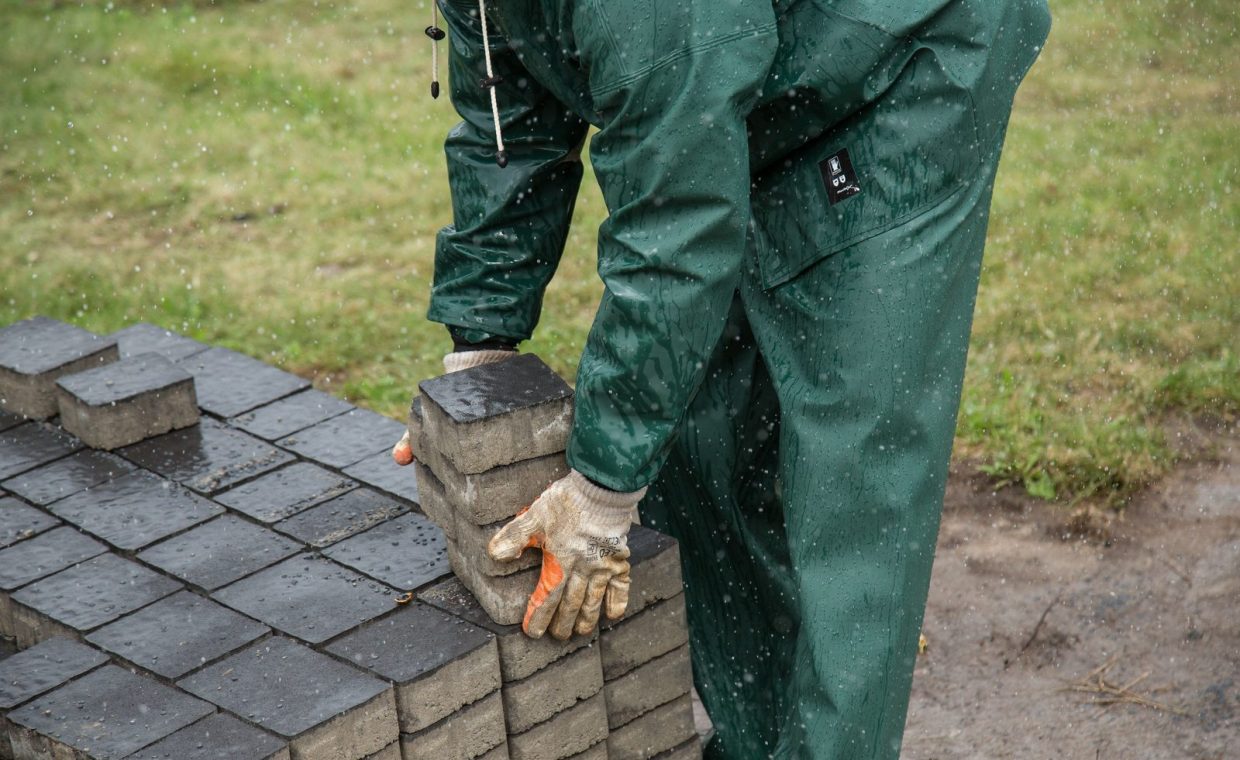
Pavers are individual units (concrete or clay brick) set on a compacted gravel and sand base. They cost more in labor because someone is placing each piece by hand.
Natural stone (bluestone, flagstone, travertine, limestone) is the premium tier. You're paying for quarried material plus the skilled time it takes to fit irregular pieces together cleanly.
What each one really costs installed
Here are realistic, illustrative ranges for a typical residential patio, materials and labor combined. Your local labor market and site access can swing these a lot.
- Poured concrete: roughly $8 to $18 per square foot. A plain broom finish sits at the low end; stamped or colored concrete pushes toward $15 to $20.
- Pavers: typically around $15 to $30 per square foot, depending on the paver style and pattern complexity.
- Natural stone: roughly $25 to $50 per square foot, with premium bluestone or intricate flagstone work climbing higher.
On a 320-square-foot patio, that's a rough swing from $2,600 on the cheap concrete end to $16,000 on the high stone end. Same square footage, wildly different checks.
For concrete, materials are cheap and most of your cost is labor plus the slab prep. For pavers and stone, you're paying for a deeper excavated base (often 6 to 8 inches of compacted gravel) and the hand-setting labor. Skimp on that base and you'll pay again in two years.
Line items people forget
Permits run roughly $50 to $400 in many municipalities, and some areas require one for any patio over a certain size. Always check before the concrete truck shows up.
Then there's the base prep, drainage grading, and edge restraints for pavers (roughly $1 to $3 per linear foot of edging). Demolition of an old slab is its own line, often $2 to $6 per square foot to break up and haul away.
Side-by-side: cost, lifespan, upkeep, risk
| Factor | Poured Concrete | Pavers | Natural Stone |
|---|---|---|---|
| Installed cost (per sq ft) | $8-$18 | $15-$30 | $25-$50 |
| Typical lifespan | 25-30 years (with cracks along the way) | 30-40 years | 50+ years |
| Upkeep | Low day to day, but crack repair and re-sealing every few years | Re-sand joints, occasional re-level, pull weeds from seams | Periodic sealing, re-set shifted pieces; very durable otherwise |
| Repair if damaged | Hard. Patches show; full sections may need re-pouring | Easy. Lift and swap a single unit | Moderate. Match and re-set the affected stone |
| Main risk | Cracking from freeze-thaw and settling | Joint weeds and uneven settling if base was rushed | Cost overruns; some stone gets slick when wet |
| Resale appeal | Neutral, expected | Strong | Strongest |
Upkeep is the line item people underestimate
Concrete looks cheapest on paper, and it often is. But in freeze-thaw climates a slab will eventually crack, and a crack in a continuous pour is the one repair that always looks like a repair.
Pavers win the maintenance argument in a way that surprises people. When one gets stained or chipped, you pop it out and drop in a replacement from your leftover stash. No patch, no color mismatch, no jackhammer.
Stone asks for sealing every couple of years to fight moisture and stains, but the material itself basically outlives the house. I've re-set heaved flagstone that was older than the homeowners and still perfectly good.
Order 5 to 10 percent more pavers or stone than the job needs and stash them. Five years from now the exact color and lot may be discontinued, and a stockpiled handful turns a visible repair into an invisible one.
What actually moves your price up or down
Site access is the quiet budget killer. If a crew has to wheelbarrow base material through a narrow side gate instead of backing a truck up, labor hours climb fast.
Pattern and shape matter too. A simple running-bond paver layout is cheaper than a herringbone with a soldier-course border, and curves cost more than straight runs because of all the cutting.
- Pushes cost up: poor drainage requiring regrading, removing an old slab, intricate patterns, premium stone, tight access, retaining or steps.
- Pulls cost down: easy truck access, a simple rectangle, standard concrete pavers over premium stone, scheduling in the off-season when crews are hungrier.
This same materials-versus-labor logic shows up in other hardscape decisions, which is exactly the tension I dig into when comparing a driveway in asphalt versus concrete. The cheaper surface upfront is not always the cheaper surface over a decade.
So which one wins, and for whom?
If your budget is tight and you mainly want a clean, usable surface for a grill and a table, poured concrete is the honest answer. Spend a little extra on a quality finish and proper control joints, and you'll get years out of it.
If you want the best balance of looks, durability, and easy repairs, pavers are my default recommendation for most homeowners. They cost more than concrete but reward you every time a single unit can be swapped instead of a whole slab re-poured.
If the patio is the centerpiece of the yard and you plan to stay put, natural stone earns its premium in character and longevity. Just budget honestly, because stone is where I see projects drift over their number. If you're staging a bigger outdoor push, my backyard makeover budget breakdown helps you decide whether the splurge belongs in the patio or somewhere with more daily payoff.
And a gentle reality check: a $12,000 stone patio is a real chunk of money, often more than a couple of replacement windows. Make sure the surface earns that spend in how often you'll actually sit on it.
Are pavers really worth almost double the cost of concrete?
For most homeowners, yes, if you plan to stay more than a few years. Pavers resist the all-or-nothing cracking that plagues slabs, and a damaged unit is a five-minute swap rather than a patch or re-pour. The upfront premium buys you cheaper, less visible repairs down the line.
Does a patio surface affect home resale value?
A well-built patio in any material reads as usable outdoor living space, which buyers like. Pavers and natural stone tend to photograph and show better than plain concrete, so they can nudge perceived value, but the build quality and layout matter more than the material alone.
Which patio material handles freeze-thaw climates best?
Pavers and natural stone, because they flex at the joints instead of cracking as one rigid piece. Concrete can survive cold climates fine with proper control joints and a good base, but it is the surface most likely to show a visible crack after a few hard winters.
Walk your yard before you sign anything. Picture where the chairs go, how often you'll really be out there, and whether you're the swap-a-paver type or the pour-it-and-forget-it type. Match the surface to how you live, and the spend stops feeling like a gamble. That's the part no quote can decide for you.