
It is 14 degrees outside, the furnace has stopped, and a technician is standing in your basement with a clipboard. He says the inducer motor is dead. The fix runs about $600, but he mentions, almost as an aside, that the unit is 17 years old and the heat exchanger "won't last forever." Now you are not deciding on a $600 repair. You are deciding whether to keep feeding an old machine or write a check for a new one.
I have sat in that basement, and I have called around afterward to figure out whether the advice was fair or just a convenient upsell. The honest answer is that the math is usually clearer than it feels in the moment. Age, the size of the repair, and your energy bill tell you most of what you need to know.
What follows is where repair still makes sense, where replacement quietly becomes the better deal, and how to keep a salesperson from rushing you into the more expensive choice.
What a Furnace Repair Actually Costs
Most furnace repairs are smaller than people fear. A common service call lands somewhere around $150 to $450, and plenty of issues fall in that band: a bad flame sensor, a clogged condensate line, a failed igniter, a stuck pressure switch.
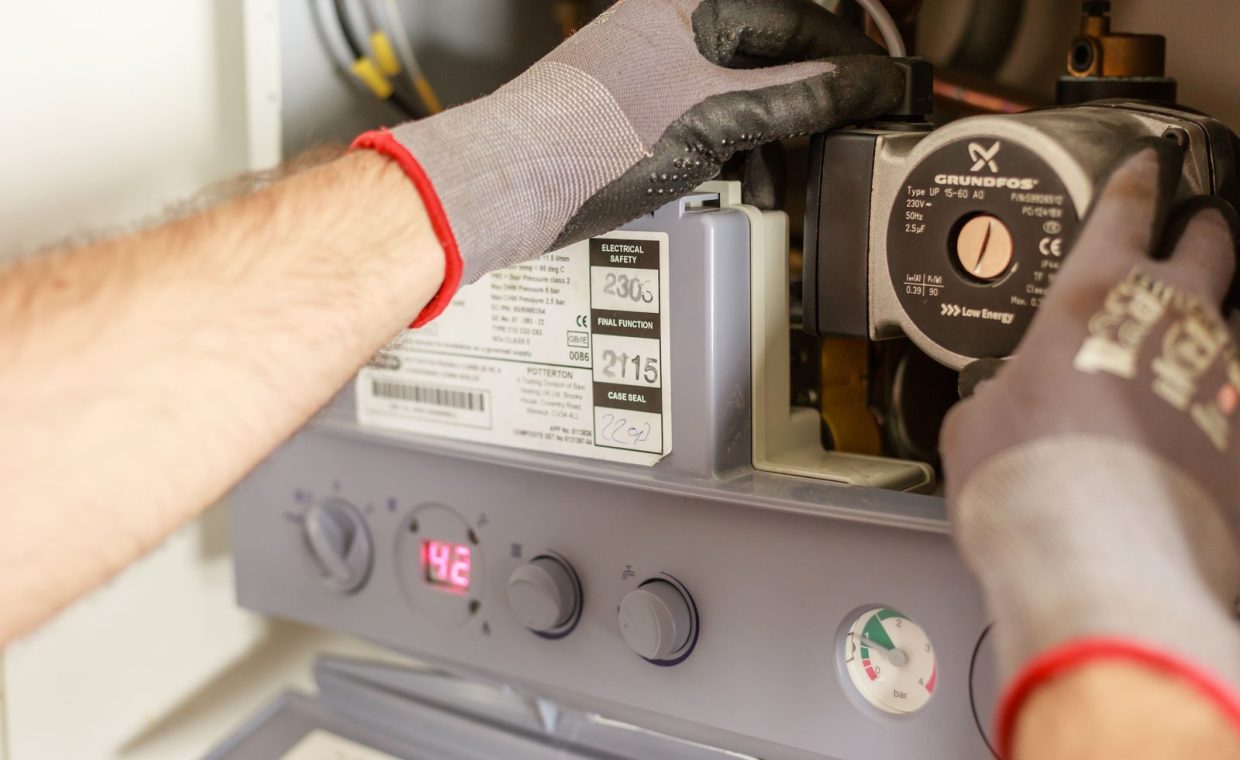
The middle tier is where it starts to sting. An inducer motor, a blower motor, or a gas valve typically runs roughly $400 to $900 installed, depending on the part and your local labor rates. These are usually worth it on a unit under about 12 years old.
Then there is the repair that changes the conversation: a cracked heat exchanger or a failed control board on an older unit. A heat exchanger swap alone can run roughly $1,500 to $2,500, and on a 15-year-old furnace that money is going into a machine that may not give you many more winters.
Ask the technician to write down the exact failed part and the split between part and labor. A vague "the motor went" is harder to price-check than "draft inducer motor, $310 part, $240 labor." That note lets you call a supply house and confirm you are paying a fair rate.
What a New Furnace Install Runs
A new gas furnace, installed, typically lands around $4,000 to $7,500 for most homes. The spread is wide because it covers the size of your house, the efficiency rating you choose, and whether the installer has to modify ductwork or gas lines.
A basic 80 percent efficiency (AFUE) unit sits at the lower end. A 95 to 97 percent high-efficiency furnace costs more upfront, often $1,000 to $2,000 more, because it needs different venting and a condensate drain. In cold climates with high gas bills, that premium can pay for itself. In a mild climate, it may not.
One thing to watch: if your air conditioner sits on the same system and is also aging, some homeowners replace both at once to save on labor. It is worth pricing, and I cover that tradeoff in our AC installation cost breakdown so you can see whether bundling actually saves money or just pads the invoice.
The Two Numbers That Decide It: Age and the 50 Percent Rule
A gas furnace usually lasts 15 to 20 years. Past 15, you are on borrowed time, and parts get harder to source. That is the first number.
The second is the 50 percent rule, sometimes called the $5,000 rule. If the repair costs more than half the price of a new furnace, lean toward replacing. The sharper version multiplies the repair cost by the furnace's age, and if that number tops about $5,000, replacement is usually the smarter spend.
Here is the math in plain terms. A $700 repair on a 4-year-old furnace is $2,800. Easy repair. The same $700 repair on a 15-year-old unit is $10,500, which screams replace. You are not just paying for the part. You are betting on the winters that machine has left.
Multiply the quoted repair by the furnace's age in years. Under $5,000, repair is usually fine. Over $5,000, start getting replacement quotes. It is a blunt rule, but it cuts through the pressure of a cold-basement sales pitch surprisingly well.
Repair vs Replace, Side by Side
Here is how the two options stack up once you put them next to each other. I built this from what installers quote and what homeowners actually report paying, not from a brochure.
| Factor | Repair | Replace |
|---|---|---|
| Upfront cost | Roughly $150 to $2,500 | Typically $4,000 to $7,500 |
| Best for furnace age | Under 12 years | 15 years and up |
| Remaining lifespan | However long the old unit has left | 15 to 20 years |
| Efficiency | No change (often 80% AFUE on older units) | Up to 95 to 97% AFUE |
| Monthly energy bill | Stays the same | Can drop noticeably on old, inefficient units |
| Risk of next breakdown | Higher on aging units | Low, plus a fresh warranty |
| Warranty | Short (part only, if any) | 10 years on parts, common |
When Repair Still Wins
Replacement is not always the answer, and a good advocate will tell you when to keep your money in your pocket.
If your furnace is under about 10 years old, the repair is a single common part, and the unit has otherwise run well, fix it. A $300 igniter on a 7-year-old furnace is not a decision. It is a Tuesday.
The same logic applies to other home systems where age and repair cost drive the call. We use the same framework for a water heater tank vs tankless decision, where a young tank with a bad element is an easy repair, and for big-ticket structural work like foundation repair cost, where the stakes and the math are larger but the question is the same: am I throwing good money after bad?
Watch for these upsell tactics
- The scare on the heat exchanger. A cracked exchanger is a real safety issue, but ask to see the crack or the carbon monoxide reading. Some companies condemn a unit on a "hairline" they never show you.
- The same-day discount. "This price is only good today" is a pressure tactic, not a deal. A fair quote holds for a week.
- Skipping the cheap fix. If a tech jumps straight to "you need a new furnace" without diagnosing the actual failure, get a second opinion before you sign anything.
When Replacement Is the Smarter Spend
Replacement pulls ahead in a few clear situations, and they tend to cluster.
The first is age plus a major repair. A furnace at 15-plus years facing a heat exchanger, gas valve, or control board failure is usually telling you it is done. Pouring $1,800 into a unit that might fail again next winter is a bad bet.
The second is repeat repairs. If you have called for service two or three times in the last two years, you are slowly paying for a new furnace one part at a time, with none of the warranty or efficiency you would get from replacing.
The third is an efficiency gap. If your old unit is 80 percent AFUE or worse and your winter gas bills are high, a 95 percent furnace can shave real money off every month.
If a technician reports elevated carbon monoxide tied to the furnace, that is not a budget conversation. Shut the unit down and verify with a second pro if needed. Safety overrides every cost rule on this page.
So Which Should You Choose?
For a furnace under 12 years old with a single common failure, repair is almost always the right call. You keep thousands of dollars and the unit likely has years left.
For a furnace 15 years or older facing a repair north of about $1,500, or one that keeps breaking down, replacement is the smarter spend. You buy reliability, a fresh warranty, and usually a lower energy bill. The 50 percent rule and the age-times-cost check settle most cases in the murky middle, and getting two or three quotes keeps everyone honest.
Is it worth repairing a 20-year-old furnace?
Rarely. At 20 years a furnace is past its expected lifespan, parts are harder to find, and efficiency is poor. Unless the fix is small and cheap (a flame sensor or igniter under $250), the money is better spent toward replacement.
How much does a new furnace cost to install?
For most homes, a new gas furnace installed runs roughly $4,000 to $7,500. A basic 80 percent efficiency unit sits at the low end, while a 95 to 97 percent high-efficiency model with new venting costs more upfront but can lower your monthly gas bill.
What is the 50 percent rule for furnaces?
If a repair costs more than half the price of a new furnace, you should usually replace instead. A sharper version multiplies the repair cost by the furnace's age in years, and if that total tops about $5,000, replacement is generally the better value.
If you take one thing from all this, let it be the habit of running the numbers before you feel rushed. Write down the part, the price, and the age, then do the quick multiplication. A failing furnace is stressful, but the decision underneath it is just arithmetic, and arithmetic does not care how cold your basement is.